On this page
Microsoft is advancing three related parts of the Entra authentication and recovery experience through July 2027:
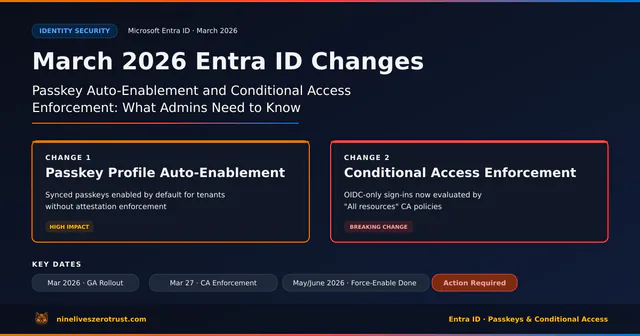
- On September 1, 2026, Microsoft began gradually moving users enabled for SMS or voice into the Microsoft-managed passkey Registration Campaign.
- SSPR is moving toward accepting only explicitly registered authentication methods. Microsoft has updated the rollout timing, and the currently published sources show different October and November sequences.
- On February 1, 2027, Microsoft-provided SMS and voice delivery retires for most public-cloud Entra ID users, including internal guests. Global Administrators and external users follow on July 1, 2027, according to the retirement FAQ. Security questions then retire for SSPR in March 2027.
There is a lot to like in this direction: broader passkey adoption, a clearer registration trust boundary, and less reliance on Microsoft-provided telecom. Because each improvement touches a different workflow, administrators should give sign-in and recovery their own readiness checks.
Passkeys meaningfully strengthen sign-in and MFA. Today, password reset still requires a separately supported SSPR method.
A user may be ready to sign in with a passkey while still needing a supported method for password reset. Similarly, a phone number or alternate email in the directory can provide useful profile data without yet representing a formally registered recovery method.
This post brings the timelines together, explains the evidence administrators need, and offers a practical way to prepare as Microsoft introduces the changes.
Public timeline and provider guidance rechecked September 25, 2026. The original August tenant evidence retains its dates. Future rollout behavior is Microsoft-documented rather than treated as a result already observed in the tenant.
A Clear Direction with One Schedule to Recheck
| Date | Change | What administrators should do |
|---|---|---|
| September 1, 2026 | Microsoft began a gradual rollout that auto-enables passkeys and moves SMS/voice-enabled users into the Microsoft-managed passkey Registration Campaign. Confirm the effective state in each tenant. | Review effective policy scope, passkey profiles, campaign exclusions, MFA bootstrap paths, and Conditional Access. |
| October 5 / November 9, 2026 | Sequence to recheck. Current sources agree on the explicit-registration direction but do not yet align on the registration-campaign and enforcement sequence. | Complete explicit-method readiness by October 5, the earliest enforcement date in current updated public guidance, and verify the final sequence before rollout. |
| September 18 / October 30, 2026 | Choose Your Own Telephony Provider details are published for the private preview. Configuration is scheduled for October 30; confirm availability before planning a production dependency. | Evaluate Soprano or Telesign coverage, charges, and the Azure routing-function prerequisite in the provider FAQ. |
| February 1, 2027 | Microsoft-provided SMS and voice delivery retires for public-cloud users except Global Administrators and external users. Internal guests remain in this February group. Users in scope who have only SMS/voice MFA and no configured replacement provider receive a blocking passkey-registration prompt. | Complete the move to durable sign-in methods or configure a customer-managed telecom provider, preserve an independent SSPR path, and account for Microsoft's no-opt-out February enforcement. |
| March 2027 | Security questions retire for SSPR. | Adopt supported alternatives for end-user recovery. Security questions are already unavailable to administrators. |
| July 1, 2027 | Microsoft-provided SMS and voice retires for Global Administrators and external users. The blocking registration behavior has no opt-out for this population. | Prepare phishing-resistant sign-in now. Only Global Administrators receive the later administrator date; validate each administrator's SSPR recovery path separately. |
Microsoft revised tenant-private MC1325414 on August 4, moving its planned rollout from early September to early November. The June What’s New announcement still displays the superseded July 6 / September 7 sequence. The current security-updates post uses October 5 prompting and November 9 enforcement. Current Learn guidance and its public GitHub source place the registration campaign on November 9 but explicit-method enforcement on October 5. MC1325414 places the campaign on October 5, enforcement in its rollout body on November 7, and November 9 in its title, summary, and action language. The linked MC1325414 copy is a community archive of a tenant-private Message Center notice, not a Microsoft publication.
The implementation sequence still warrants a fresh check, but the design direction is consistent across the sources: SSPR will rely on explicitly registered methods rather than unregistered directory contact data. For conservative planning, complete explicit-method readiness by October 5, the earliest enforcement date in current updated public guidance, and confirm the final sequence before rollout.
Entra Authentication Transition Map: 2026–2027
Passkey expansion, evolving SSPR timing, telecom delivery retirement, and recovery changes affect different controls.
Passkey rollout begins for SMS/voice-enabled users
Documented milestoneMicrosoft begins a gradual rollout for in-scope users. Confirm effective passkey profiles and Registration Campaign settings in the tenant; September 1 is not universal completion.
Telephony provider offers published
AnnouncedThe Choose Your Own Telephony Provider private preview lists Soprano and Telesign. Review offers and provider-dependent pricing in Microsoft Security Store.
SSPR campaign and enforcement sequence
Sequence to recheckCurrent Learn and GitHub place explicit-method enforcement on October 5 and the registration campaign on November 9. Other published sources place the campaign first and enforcement in November. Complete explicit-method readiness by October 5 and recheck the sequence before rollout.
June What’s NewSuperseded schedule still displayedJul 6 prompt · Sep 7 ruleSecurity-updates detailOct 5 promptNov 9 ruleLearn + GitHubNov 9 promptOct 5 ruleMC1325414 · tenant-privateUpdated Aug 4 · Oct 5 campaignNov 7 enforcement body · Nov 9 title, summary, actionPublic source snapshot rechecked August 12, 2026. Recheck before each implementation milestone.
Compare four published schedules
June What’s NewSuperseded schedule still displayedJul 6 prompt · Sep 7 ruleSecurity-updates detailOct 5 promptNov 9 ruleLearn + GitHubNov 9 promptOct 5 ruleMC1325414 · tenant-privateUpdated Aug 4 · Oct 5 campaignNov 7 enforcement body · Nov 9 title, summary, actionPublic source snapshot rechecked August 12, 2026. Recheck before each implementation milestone.
First-MFA-method passkey registration phase
AnnouncedEligible password-only users can register a synced passkey, Microsoft Entra passkey on Windows, or FIDO2 security key as their first MFA method. Tenant validation is pending (MC1450133).
Telephony configuration scheduled
AnnouncedConfiguration is scheduled to open in the Entra admin center. Plan for a routing function in your Azure subscription, one provider per channel and evaluation mode. See the linked provider guidance below.
Microsoft-provided SMS and voice delivery retires
Retirement · no applicable opt-outRetirement applies to all users except Global Administrators and external users, including internal guests in the February population. Configure supported alternatives or a customer provider where appropriate. SMS primary sign-in is not preserved by choosing a provider.
Security questions retire for SSPR
Month publishedSecurity questions retire as an end-user SSPR verification method. The month is published; the specific day remains to be confirmed.
Remaining telephony populations retire
No applicable opt-outMicrosoft-managed SMS and voice retirement reaches Global Administrators and external users. Validate emergency-access and external-user plans before this separate deadline.
Passkey Readiness and SSPR Readiness Are Different
Microsoft’s current authentication-method matrix helps clarify the two readiness tracks. It lists passkeys, synced passkeys, Windows Hello for Business, certificate-based authentication, and Temporary Access Pass as unavailable for SSPR.
Authenticator push, software OATH, hardware OATH tokens in preview, and email OTP can support SSPR when policy permits them. SMS and voice can support it only while a delivery path remains. Security questions remain a legacy end-user option until their March retirement.
That creates two separate questions:
- Sign-in and MFA: Can the user register and successfully use a durable replacement, preferably a passkey or another phishing-resistant method, without Microsoft-provided SMS or voice?
- SSPR continuity: Will the user still have enough explicitly registered, policy-allowed SSPR methods after telecom delivery and security questions are removed?
Microsoft Entra Account Recovery, generally available since May 2026, offers a separate total-loss path when a user loses every registered authentication method. It uses a third-party identity-verification provider, Verified ID, and Face Check; after successful verification, the user receives a limited-validity Temporary Access Pass to re-enroll methods. It is not an SSPR method. Production planning should account for Entra ID P1 licensing and configuration prerequisites, provider pricing through Microsoft Security Store, and privacy, data-retention, and regional-compliance review for government-ID and biometric processing.
Passkey and SSPR Readiness Work Best as Two Tracks
Move from useful directory context to registration evidence, then evaluate the sign-in and password-reset branches independently.
- 01
Directory contact
mobilePhone · businessPhones · otherMailsUseful profile context. Authentication-method registration is confirmed through Security info.
Signal · not a method - 02
Explicit registration
The method exists in Security info after a supported user or administrator registration path.
Registration evidence - 03
Policy and workflow allowed
Correct scope, method type, profile, and required count. Apply the controls for the branch being tested.
Policy evaluation - 04
Durable after delivery ends
No dependency on Microsoft-provided SMS or voice. Device-loss, replacement, and recovery paths are tested.
Durability evidence
Sign-in and MFA
- A passkey or another durable strong method is registered.
- Required devices, browsers, and native applications support it.
- Conditional Access and authentication-strength requirements can be met.
SSPR continuity
- An SSPR-supported method is registered and allowed.
- The applicable SSPR scope and the end-user or administrator method-count policy are satisfied.
- The reset flow, including hybrid password writeback when used, is tested end to end.
What the September 1 Change Enables
Microsoft’s SMS and voice retirement guidance describes a policy migration rather than an immediate passkey mandate:
- Users enabled for SMS or voice through the Authentication Methods Policy or legacy MFA settings are enabled for passkeys.
- Microsoft assigns those users an all-passkey-types profile.
- Microsoft sets the passkey Registration Campaign to Microsoft managed.
- Eligible users can then be prompted to register during a later sign-in.
The prompt begins the registration journey, and a successful experience still depends on AAGUID rules, attestation requirements, device and browser support, Conditional Access for Register security information, terms of use, and a valid MFA bootstrap. A tenant can target one method in Registration Campaign at a time, so plan the transition from an existing Authenticator campaign to a passkey campaign deliberately.
The September auto-enablement population is tied to SMS- or voice-enabled users. Separately, Microsoft says Microsoft-managed passkey Registration Campaign targeting is gradually expanding from voice/text users to all MFA-capable users. Review campaign exclusions and the user experience beyond the initial SMS/voice cohort.
The temporary opt-out requires Policy.ReadWrite.AuthenticationMethod. Microsoft documents this beta Graph request:
PATCH https://graph.microsoft.com/beta/policies/authenticationmethodspolicy
Content-Type: application/json

{
  "optOutSettings": {
    "passkeyDynamicMigration": true
  }
}
The property name deserves a careful read: true means opt out of the automatic September migration. This setting applies to the September automation; the applicable February 1 or July 1, 2027 retirement remains on its own schedule.
Two population details deserve separate planning:
- The retirement timeline currently applies to public-cloud tenants. Tenant-private MC1325414, as reproduced by the community archive, says the SSPR registered-method change applies to Public, GCC, GCC High, and DoD. Confirm the notice and rollout details in your own tenant’s Message Center, and verify scope for each announcement independently.
- Internal guests follow February 1, 2027; external (B2B) users follow July 1, 2027. Current Registration Campaign guidance says guests are not nudged for passkeys. Microsoft says guest passkey support is planned by the end of 2026.
A later tenant-private Message Center notice, MC1450133 as preserved by a community archive, describes a phased change for eligible password-only users to register supported passkeys as their first MFA method. Confirm the latest dates and cloud scope in your own tenant notice; the community archive is not tenant-authoritative evidence. While public guidance is being completed, retain a controlled bootstrap path and validate the experience with representative users under the tenant’s actual policy.
Profile Data and Registered Methods Serve Different Purposes
The portal can show the same phone number in more than one context, so it helps to distinguish profile contact data from authentication-method registration.
| Evidence | What it establishes |
|---|---|
/users: mobilePhone, businessPhones, otherMails | A contact value exists on the directory profile. Registration status comes from the authentication-method data. |
/reports/authenticationMethods/userRegistrationDetails | Microsoft reports registered method categories and whether the user is enabled, registered, and capable for SSPR. |
Microsoft currently documents a helpful bridge in which a prepopulated mobile phone or alternate email can be used before the user completes registration. The announced design makes explicit registration the authoritative path for future SSPR eligibility.
Include Office phone in the transition review. On-premises telephoneNumber synchronizes to businessPhones, which appears as Office phone, and Office phone supports voice calls only. Even where office numbers are broadly populated, teams still need to account for the move to explicit registration and the later retirement of Microsoft-provided voice delivery.
Updating the /users/{id} profile property mobilePhone with Graph, or populating it through synchronization, remains profile maintenance rather than authentication-method registration. Complete the transition through a supported user or administrator registration experience.
The registration report exposes three related but different flags:
isSsprEnabled: policy permits SSPR for the user;isSsprRegistered: the user has registered the required number of methods; andisSsprCapable: the user currently has enough registered, allowed methods to use SSPR.
isSsprCapable is the strongest single registration-report field for current SSPR policy capability. It does not prove that an end-to-end reset succeeded, and it cannot predict which methods will remain after SMS, voice, or security questions retire.
Explicit Registration Becomes the SSPR Trust Boundary
Profile contact remains useful directory context, while SSPR eligibility moves to explicitly registered methods and established policy checks.
Directory profile only
mobilePhone · businessPhones · otherMailsPrepopulated contact can be used before formal registration. This tenant did not transaction-test that bridge.
Complete supported registration before using this value for SSPR verification.
Explicitly registered method
Eligible authentication method stored in Security info
The registered method proceeds to SSPR policy evaluation when that method is allowed.
- User is SSPR-enabled.
- Method is allowed.
- Required method count is met.
Start with the Microsoft Analyzer, Then Add User Evidence
Microsoft’s open-source Entra SMS/Voice Policy Scanner (microsoft/entra-sms-voice-usage-analyzer, implemented as Get-SmsVoicePolicyUsers.ps1) gives administrators a useful, repeatable first view of Registration Campaign state and SMS/voice policy targets.
The August 12 review found a January 28 versus February 1 discrepancy. Microsoft corrected the scanner on September 7 to use February 1, 2027. Use the current Learn population-specific timeline, including July 1 for Global Administrators and external users, and use the scanner for its policy-scope role.
The scanner focuses on policy configuration. Complete the readiness view by adding effective group membership, residual legacy MFA and SSPR settings, per-user registration, recent method use, and separate passkey and SSPR validation.
A practical inventory uses at least three evidence layers:
- Policy: Who is effectively targeted through modern and residual legacy settings?
- Registration: Which methods does each user have, and is the user currently SSPR-capable?
- Observed use: Which methods appear in recent Authentication Methods Activity and sign-in Authentication Details?
Authentication Methods Activity and the related Usage and insights APIs require Microsoft Entra ID P1 or P2.
For population-level SSPR review, start with two Graph reads:
GET /v1.0/users?$select=id,accountEnabled,userType,mobilePhone,businessPhones,otherMails
GET /v1.0/reports/authenticationMethods/userRegistrationDetails
Join them by the Entra user object ID (id) returned by both datasets and reduce phone and email values to presence signals before saving output. Keep in mind that Authentication Methods Activity can lag, so treat a missing recent event as inconclusive rather than evidence of non-use.
Follow every returned @odata.nextLink for both collections; /users returns 100 objects by default. Plan a separate classification for disabled and soft-deleted users because the userRegistrationDetails list API does not support disabled users and the portal omits both populations. Treat a missing registration-report row as unresolved rather than “unregistered.”
What the Controlled Tenant Showed
The following aggregates describe retained private tenant evidence. The collection scripts and detailed evidence are not publicly published, so readers cannot independently reproduce these historical counts from a linked source bundle. They illustrate the method/registration distinction and do not certify any reader’s tenant or a completed future rollout.
The live review was read-only by design. Future rollout behavior and the directory-only reset path remain clearly labeled for validation after the change reaches the tenant.
Our audit classified the August 5 registration snapshot of 23 users as 3 Ready, 2 AtRisk, and 18 NotInScope. Those are audit-defined states, not native Microsoft report values; they were derived from fields such as isSsprEnabled, isSsprRegistered, and isSsprCapable.
On August 12, a fresh read-only collection returned all 23 rows with an August 10 report timestamp at about 02:22 UTC. That dated snapshot retained the same distribution: 3 Ready, 2 AtRisk, and 18 NotInScope. Microsoft says most registration-report rows update within 36 hours, while occasional rows can take longer. Because the report snapshot was about 64.7 hours old when collected, our conservative 48-hour gate withheld a current readiness verdict. The cohort below publishes the known August 10 snapshot states and labels them as dated evidence rather than presenting them as current tenant status.
The portal showed SSPR enabled for a dedicated four-member validation group with one end-user method required. Registration Campaign was Microsoft managed and still targeted Microsoft Authenticator. SMS, voice, and passkeys were disabled in the current Authentication Methods Policy. A separately completed SSPR transaction by an administrator account later appeared in event history as successful with Authenticator push. The event was absent from the earlier activity snapshot and present in the later one. The audit did not capture notification delivery or a post-reset sign-in.
The four controlled states separated directory contact from registration:
Four Accounts Illustrate Profile and Registration Signals
The August 12 read-only collection returned an August 10 registration-report snapshot. Its states are useful dated evidence, not a current tenant verdict.
One dated report, four controlled setups
The snapshot records registration and capability as reported on August 10.
| Account | Controlled setup | Aug 10 snapshot | Snapshot evidence |
|---|---|---|---|
| 01Empty controlBaseline case | No directory contact; no eligible registered method. | AtRisk | Not registered and not SSPR-capable.Dated report state. |
| 02Directory-onlyTransition candidate | Profile alternate-email signal only; no registered method. | AtRisk | No registered method reported.Dated report state. |
| 03Registered emailRegistered method | Email registered; report snapshot says registered and capable. Actor not retained. | Ready | Registered and SSPR-capable.Dated report state. |
| 04Software OATHRegistered method | Software OATH registered; report snapshot says registered and capable. Actor not retained. | Ready | Registered and SSPR-capable.Dated report state. |
Expected after the explicit-method rule
These are expectations, not observed tenant results.
No registered method
A supported method must be registered before SSPR can proceed.
Profile-only value
The alternate-email signal remains directory context; explicit registration becomes the SSPR path.
Registered method
Expected to continue if the method remains allowed by policy.
Ready and AtRisk are audit-defined snapshot states, not native Microsoft report values. The August 12 collection returned an August 10 report timestamp, so this table does not claim current readiness.This evidence demonstrates the distinction between profile data, registered methods, and current report state. Its scope is intentionally limited; future enforcement behavior, actual SMS/voice dependency, passkey usability, hybrid writeback, notification delivery, and Account Recovery completion remain separate validation tasks.
A Practical Two-Track Plan
Track 1: Guide sign-in and MFA toward durable methods
- Map effective scope. Review SMS and voice targets in the Authentication Methods Policy, effective group membership, and residual legacy MFA settings. Keep policy targeting and observed user activity as separate evidence.
- Separate registration from use. Combine per-user registration with recent method-level sign-in evidence where available. Treat “SMS/voice only” as a conclusion that requires both a complete method inventory and the absence of a usable alternative.
- Pilot passkeys end to end. Validate profile assignment, registration, representative devices and browsers, Conditional Access, and a real sign-in. Keep Temporary Access Pass or another controlled identity-proofing path for bootstrap until MC1450133 behavior is available and tested.
- Design for exceptions. Give guests, emergency accounts, service accounts, unsupported devices, and infrequent users clear workstreams. Evaluate a customer-managed telecom provider when published details, coverage, and costs fit the requirement.
Track 2: Maintain SSPR continuity
- Model the future method count. Remove Microsoft-provided SMS and voice at the applicable February or July retirement date, and security questions from the March scenario. Count only explicitly registered methods that remain supported and allowed for SSPR.
- Complete supported SSPR registration. Treat directory properties, passkeys, Windows Hello, CBA, TAP, and Account Recovery according to their documented roles, and make sure each user has a supported SSPR method.
- Review special recovery paths. Administrators, hybrid password writeback, federated users, and total-loss Account Recovery each need representative testing outside the normal end-user flow.
- Allow for reporting latency and rerun. A completed registration is not current registration-report evidence until the reporting plane catches up; the transaction itself can still be separate operational evidence. Rerun after each rollout reaches the tenant instead of projecting today’s result into February or March.
Use Separate Readiness Signals
At minimum, report these decisions separately:
- Passkey/sign-in ready: a durable method is registered and successfully used under the intended device and Conditional Access conditions.
- SSPR report-capable: a current registration-report row says the user is enabled, registered, and capable.
- SSPR operationally validated: a representative reset succeeds end to end, including post-reset sign-in, writeback where applicable, and expected notification behavior.
- SSPR projected capable after retirement: enough explicitly registered, allowed SSPR methods remain after telecom delivery and security questions are removed.
- Exception assigned: any remaining telecom, guest, hybrid, administrator, or total-loss recovery requirement has an owner and a tested path.
Microsoft’s passkey expansion advances phishing-resistant authentication, while explicit registration strengthens confidence in SSPR data. The telecom and security-question retirements also provide a natural point to modernize recovery paths. Because these improvements affect different controls, the clearest readiness view keeps their outcomes separate.
Use the policy scanner as the first layer, add registration and use evidence, pilot passkeys, and maintain an independent supported SSPR method. Completing these checks early gives users a smoother transition and gives the help desk clear options for both sign-in and password recovery.

Jerrad Dahlager, CISSP, CCSP
Cloud Security Architect · Adjunct Instructor
Marine Corps veteran and firm believer that the best security survives contact with reality.
Have thoughts on this post? I'd love to hear from you.