
threat-hunting
Lessons from the field. Always landing on my feet.

GigaWiper Detection as Code: Testing Custom Detections in Sentinel Repositories
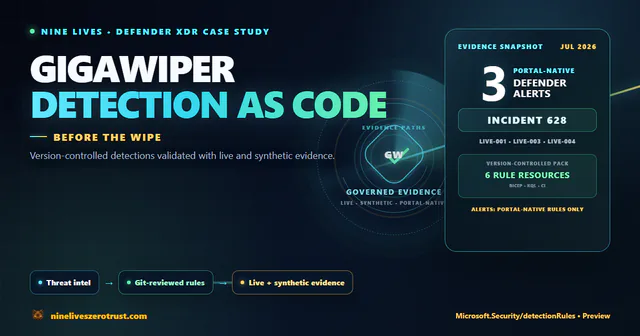
Review update (September 25, 2026): The merged September 25 source now chooses a labeled executable identity from populated SHA1, then SHA256, then a normalized path; it excludes empty identity values. Its KQL semantic analysis and offline suite …
From Authorization to Action: Operationalizing CISA's Microsoft Cloud Logs Playbook in Sentinel
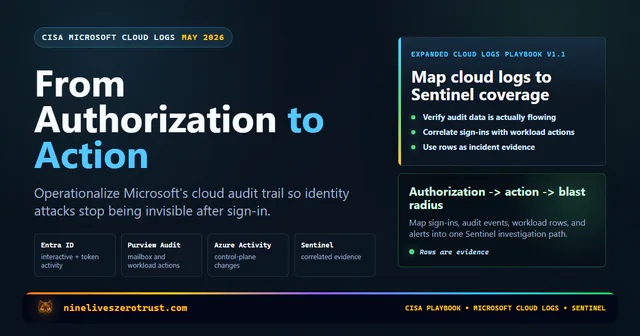
Review update (September 25, 2026): The January 15, 2025 publication date is supported by CISA’s original release notice; the resource landing page now emphasizes the later revision date. Review update (September 25, 2026): For cost planning, …
Block Device Code Phishing in Entra Without Breaking Legit Workflows
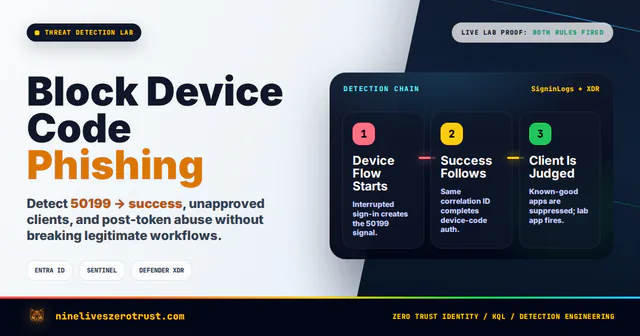
Review update (September 26, 2026): The merged rules run every 15 minutes, retain their correlation lookbacks, and gate on recent ingestion from either relevant side. Rule 2 merges duplicate representations of a successful sign-in while retaining …
Detecting Infostealer Session Hijacking with Microsoft Sentinel
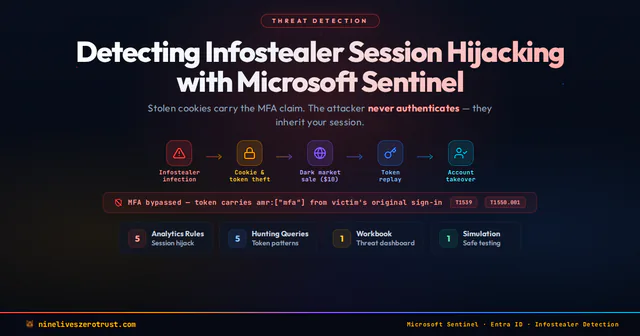
Review update (September 25, 2026): Cookie replay maps to T1550.004 separately from cookie theft (T1539); these rules provide investigative signals rather than proof of either technique. Keep the sign-in tables used by scheduled rules in the …
Detecting OAuth Redirect Abuse with Microsoft Sentinel and Entra ID
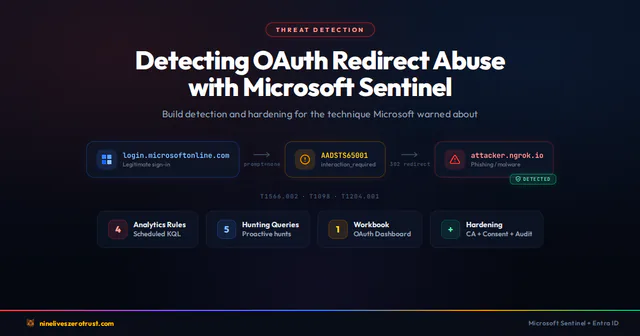
Review update (September 26, 2026): The merged source preserves an already-disabled user-consent policy and refuses unrecognized custom self-consent policy replacement for manual review. Reports, manifest staging and request-body files are …